
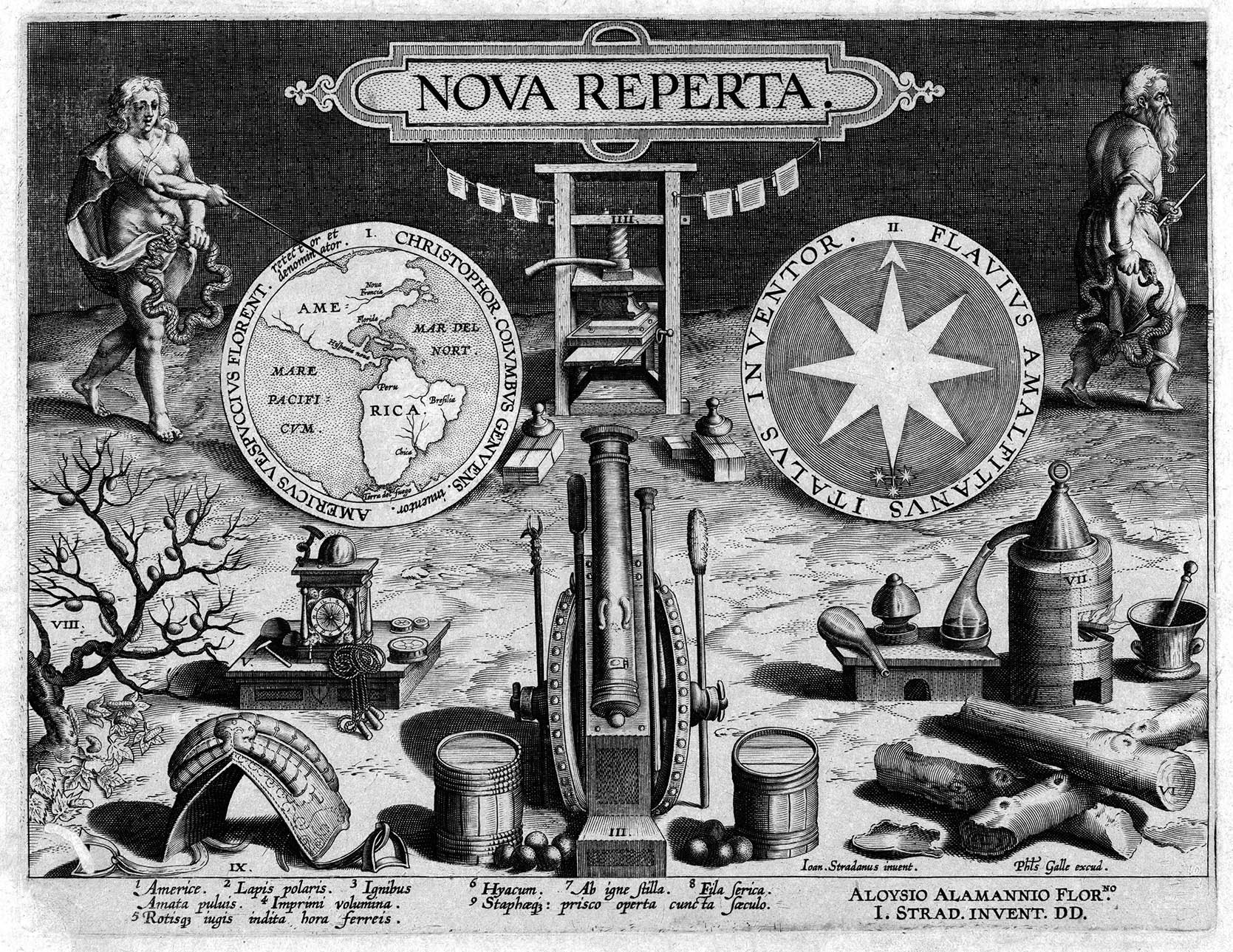
NEW INVENTIONS—The printing press is at the center of “New Inventions of Modern Times” (Nova Reperta) published in 1600 in the Netherlands by Jan Collaert. The compass, gunpowder, stirrup, clock, and chemistry follow. From the beginning, it was clear that communications revolutions would change the world more than anything else. Metropolitan Museum (public domain).
Summary
Civilizations rise and fall on the crests of great revolutions in communication, brought on by new technologies and limited only by human imagination. Well into the twenty- first century, we are witnessing these revolutions visibly transforming daily life… To understand and learn from events, to envision the possibilities of the future, we turn to history.
CHAPTER OUTLINE
People and events
History: Clio, Herodotus, Thucydides, Thomas Carlyle, Parson Weems, Melvin Kranzberg, Leopold Von Ranke, Lord John Acton, Eugene Weber, Herbert Butterfield, George Santayana, Howard Zinn,
Media history: Samuel Palmer, Isaiah Thomas, H.G. Wells, Elizabeth Eisenstein, Walter Ong, Harold Innis, Marshall McLuhan,
Concepts: Determinism, social construction, whig history, variations of historical narratives, objective history, social theories of media, utopian versus luddite approaches to technology, technological fallacies, Innis’ durable versus flexible media, McLuhan’s tetrad, hot and cool media, global village, medium is the message, alphabet effect, Gutenberg parenthesis
Extended online content
- A free pdf of the 2025 third edition Introduction is available here. This introductory chapter outlines some of the main themes and historical issues in the history of mass media. It’s meant to provide a toolkit and frame of reference for issues that come up throughout the book.
- About history ( Content extended from the textbook )
- Quick guide to historians ( Content extended from the textbook )
- Media & technology ( Content extended from the textbook )
Documentary videos
- The medium is the message — Australian television interview with Marshall McLuhan, 1977.
- Author Norman Mailer and Marshall McLuhan debate ideas about the media in this Canadian Broadcasting Corp. film from 1968.
- The Story of Communication, 20th Century Fox, 1947. An interesting and hopeful view about the promise of international communication in the post WWII environment.
Discussion questions
- Arthur Koestler once wrote: “Every jump of technical progress leaves the relative intellectual development of the masses a step behind, and thus causes a fall in the political-maturity thermometer. It takes sometimes tens of years, sometimes generations, for a people’s level of understanding gradually to adapt itself to the changed state of affairs, until it has recovered the same capacity for self-government as it had already possessed at a lower stage of civilization. (Darkness at Noon, 1940). Do you agree? Give examples from media history.
- Fr. Walter Ong studied oral cultures before, during and after the transition to writing. He distinguished between cultures which have never known writing, cultures without widespread literacy but with scribes, and literate cultures with “residual orality” that might involve fossilized rituals from a previous oral culture. Which are we in? Can you think of examples?
- How did manuscript cultures enhance life in monasteries and convents ? How quickly could monks or nuns reproduce a manuscript? How do we quantify “monk power”?
- Harold Innis, author of Empire and Communication, saw communications technologies having enormous influence on the structure of classical civilizations. What differences did he see between civilizations that had durable media versus those with flexible media?
- Marshall McLuhan sparked a debate with his observation that “the medium is the message.” What was he getting at, and do you agree?
- Visions of future communications were a mainstay of science fiction in the late 19th and early 20th centuries. With a few exceptions, most science fiction films fall back on retro communications rather than envisioning anything advanced. For example, in the Disney series Andor (2022-25), tape recorders, morse code and quarter inch patch jacks are common, despite advanced warp transportation and anti-gravity gurneys. Why the contrast?